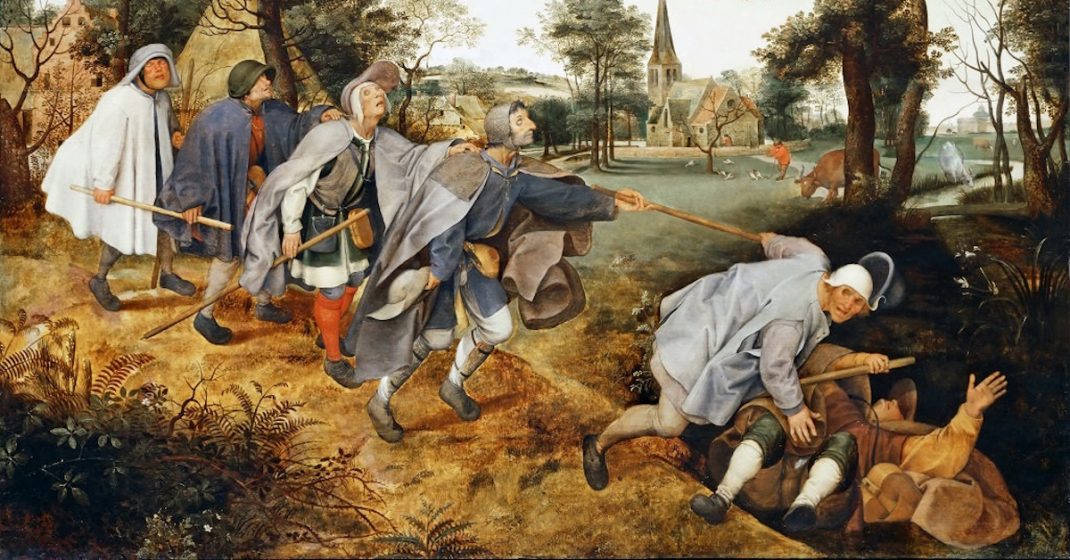
In modern Mormonism, the idea that the prophet can’t lead the church astray is woven through every aspect of the church. It is taught, in various forms, weekly from the pulpit, in regional conferences, and in the church’s general conferences. It is also implied through the temple ordinances which are taught as being essential to return to God. In Mormonism, you can’t disagree with the prophet because disagreeing with him is disagreeing with God. Many today paint the heavy-handed Brigham as the originator of this concept. However, the truth is far more complicated.
Cherry Picking
One thing I have learned from studying history, and particularly church history, is that you can make a case for almost anything by simply selecting specific sources to support your argument. There may be a different source that directly contradicts the conclusion, however that doesn’t matter if you don’t include it. This is of course intellectually dishonest. However, it is a rather common way to reach a preferred conclusion. Another way, that is really simple as well, is removing the context from a source, and making it appear in a completely different light than it originally was intended to be in. This is a common technique for proof-texting the scriptures.
For a discussion like this, I do want to illustrate that Brigham and Joseph were on both sides of this issue. They taught, at various times, that the prophet must be relied upon explicitly. However, also that the people relied too much upon the prophet and didn’t fully understand his role. Historically, for both Joseph and Brigham, there were ebbs and flows where the people didn’t rely upon the leaders enough and then they relied upon them too much, which was overwhelming. I can only imagine the mental strain it must have been to try and establish the new church among the people who all had their own ideas of how it really should be.
As mentioned previously, you can say this concept originated with Brigham, by simply choosing his statements that support this, while ignoring Joseph’s earlier statements. On the other hand, you can choose Joseph’s statements that support this concept while ignoring his statements that chide the members for doing the exact thing that he taught them to do.
If someone wants to paint Brigham in a negative light, then it is profoundly easy to do so. The same can be said about Joseph. However, since Joseph was the founder of Mormonism, then his words simply carry much more weight than Brigham’s words do. If Joseph taught a concept, that Brigham also taught, then Joseph would simply be the originator of the concept since he preceded Brigham and was frankly Brigham’s spiritual leader.
Brigham
Brigham is quite often the go to guy for everything wrong in Mormonism. This is completely understandable. We do need a fall guy, and the heavy-handed Brigham is a perfect person for that role. In an attempt to show Brigham as the originator of this concept, then many will use the following quote from Brigham.
The Lord Almighty leads this Church, and he will never suffer you to be led astray if you are found doing your duty. You may go home and sleep as sweetly as a babe in its mother’s arms, as to any danger of your leaders leading you astray, for if they should try to do so the Lord would quickly sweep them from the earth. Your leaders are trying to live their religion as far as [they are] capable of doing so.
Brigham Young, February 23, 1862
This statement is of course pretty alarming and doesn’t quite make any sense. However, it is reassuring to say the least from a member’s perspective. All the members need to do is follow and obey and they will be fine. The leaders can’t lead the people astray so there is nothing to worry about. If we stopped the discussion right there, then it would be pretty clear that Brigham expected exact obedience, and the members couldn’t be led astray if they did in fact follow the leaders exactly.
However, as with most things, the truth is far more complicated. Brigham was also quite vocal about how the members were blindly obedient and how that was not good for their spiritual standing with God. They were not exercising their ability to discern between good and evil and were instead trusting their leaders explicitly. Brigham saw that this was dangerous and would lead to a spiritually weak people. Which it frankly did. Mormonism today is spiritually weak, because the members think they are not supposed to disagree with their leaders. Along these lines, Brigham mentioned:
I am fearful [the members] settle down in a state of blind self-security, trusting their eternal destiny in the hands of their leaders with a reckless confidence that in itself would thwart the purpose of God in their salvation, and weaken that influence they could give to their leaders did they know for themselves by the revelations of Jesus that they are led in the right way.
Brigham Young, January 12, 1862
In addition to teaching that blind obedience, to the leaders, was not part of God’s plan. Brigham also taught that it was an individual responsibility for the members to know whether the leaders were teaching truth or not. He may not have literally meant it, as he likely felt he was teaching truth. However, Brigham mentioned several times that it was a possibility for the leaders to teach the members incorrectly. It was their responsibility collectively, and individually, to determine when this happened. Brigham mentioned:
The First Presidency have of right a great influence over this people; and if we should get out of the way and lead this people to destruction, what a pity it would be! How can you know whether we lead you correctly or not? Can you know by any other power than that of the Holy Ghost? I have uniformly exhorted the people to obtain this living witness each for themselves; then no man on earth can lead them astray.
Brigham Young, November 29, 1857
Based on these statements, then it appears that Brigham was simply trying to get the members to learn to listen to God and follow him. Of course, Brigham felt he was following God and that the members should consequently follow him as their leader. Almost everyone sees themselves as being correct and following the best path, whatever that is. Brigham was no different.
However, Brigham was clear that if he wasn’t following God anymore, then it was the member’s responsibility to see this and follow God instead. According to Brigham, we are individually responsible to God and can’t blame another person for our mistakes. This makes perfect sense. Even if our leaders are quite confident, that they are in fact correct, they might not be and we are to determine that.
Joseph
As with Brigham, Joseph is also on both sides of this concept. In a discussion like this, typically what happens is people use the statements from Joseph which deride exact obedience, and the statements from Brigham which support it. They then conclude Brigham as the originator of the concept. However, again the truth is far more complicated. Joseph did say that the members were relying upon him too much, which was frankly true. If he said something, they immediately accepted it as the truth. This is an incredibly dangerous place for a leader to be put in by a body of believers. The minutes for a Relief Society meeting mention:
[Joseph] said the Lord had declar’d by the prophet that the people should each one stand for himself and depend on no man or men in that state of corruption of the Jewish church— that righteous persons could only deliver their own souls— applied it to the present state of the church of Latter-Day Saints— said if the people departed from the Lord, they must fall— that they were depending on the prophet hence were darkened in their minds from neglect of themselves—
Joseph Smith, May 26, 1842
If we left the discussion with this statement from Joseph, then the conclusion would be very clear. However, there is a reason that the people were relying upon Joseph too much. It was because Joseph himself inadvertently told them to do so. He created a religious system, where the only logical thing to do would be to rely upon him explicitly. We can see this with the very scriptures which Joseph presented as the word of God.
For instance, D&C 21, which was received in 1830, explicitly tells the church that they should listen to Joseph and treat his teachings as if from God directly.
Wherefore, meaning the church, thou shalt give heed unto all his words and commandments which he shall give unto you as he receiveth them, walking in all holiness before me; for his word ye shall receive, as if from mine own mouth, in all patience and faith.
D&C 21:4-5
D&C 28, which was also received in 1830, says that only Joseph can speak for the God, pertaining to the church, and that we should be obedient to Joseph’s teachings.
I say unto thee, no one shall be appointed to receive commandments and revelations in this church excepting my servant Joseph Smith, Jr., for he receiveth them even as Moses. And thou shalt be obedient unto the things which I shall give unto him
D&C 28:2-3
D&C 43, which was received in 1831, mentions that Joseph is the only one, in the church, that can receive commandments and revelations. It also mentions that the members were not to receive any new teachings from anyone other than Joseph.
And this ye shall know assuredly—that there is none other appointed unto you to receive commandments and revelations until [Joseph] be taken, if he abide in me. … And this shall be a law unto you, that ye receive not the teachings of any that shall come before you as revelations or commandments
D&C 43:3-5
D&C 90, which was received in 1833, says that Joseph was the only person in the church, which held all the priesthood keys and was the only one able to preside over the church as prophet.
Verily I say unto [Joseph], the keys of this kingdom shall never be taken from you, while thou art in the world, neither in the world to come; nevertheless, through you shall the oracles be given to another, yea, even unto the church.
D&C 90:3-4
Lastly, D&C 107, which was received in 1835, says that Joseph was to preside over the entire church and be like Moses. He was to be a seer, a revelator, and a prophet to the church.
The duty of the President of the office of the High Priesthood is to preside over the whole church, and to be like unto Moses— behold, here is wisdom; yea, to be a seer, a revelator, a translator, and a prophet, having all the gifts of God which he bestows upon the head of the church.
D&C 107:91-92
Based on these scriptures, then we can see that the members were told, by God through the scriptures, that they were to listen to Joseph, and that Joseph was the only person they should listen to for spiritual guidance. It is understandable then why they listened to Joseph too much.
In addition to the scriptures, which were the words of God, directly to the people, then we also have a number of statements from Joseph which help to illustrate his thoughts and feelings on this concept.
For instance, Joseph mentioned that he was a god and a king to the people, and if they didn’t like it, then that was just too bad. There was nothing they could do about it. Joseph said in an 1844 conference:
It is my duty to teach those who err in doctrine … God made Aaron to be their mouthpiece & made me to be their K[ing]. & their God— & if you dont like it you must lump it
Joseph Smith, April 6, 1844
If Joseph was our god and king, then yes it certainly does make sense to listen to him explicitly and follow what he says exactly. In an 1833 letter to John S. Carter, Joseph gave instructions pertaining to missionary work and mentioned that the revelations of God followed a strict hierarchy. No one was able to receive instructions which contradicted someone higher than themselves. Joseph himself being the highest, meant no one was allowed to contradict him. In the letter, Joseph wrote:
I will inform you that it is contrary to the economy of God for any member of the Church or any one to receive instruction for those in authority higher than themselves, therefore you will see the impropriety of giving heed to them
Joseph Smith, April 13, 1833
With Joseph being the presiding official for the church, then Joseph would be saying that no one could disagree with him about anything at all. It was contrary to the workings of heaven, and if Joseph said something then it had to be correct and the church should listen to it, as if from God directly. I doubt Joseph had nefarious purposes, but this is a dangerous place to put yourself in.
Lastly, Joseph mentioned, in 1841, that if the church were to listen to him then he would get them to heaven. This was immediately after Elder William Clark had preached to the members, in Nauvoo, that they were not living up to God’s standards. Joseph got up after Elder Clark and rebuked him for not being edifying or charitable towards the members. He was not to point out faults, but instead ignore them as that was more charitable. Joseph mentioned:
If you will follow the Revelations and instructions which God gives you through me, I will take you into heaven as my back load. If you will not accuse me, I will not accuse you.
Joseph Smith, November 7, 1841
This last statement is very clear. Joseph could get the members to heaven, but they had to listen to him and not accuse him of any faults. I doubt he meant it with a negative connotation, however that is exactly how it comes across. If getting to heaven was as simple as just listening to Joseph, then why did he chide the members, just a few months later, for actually listening to him so closely?
Conclusion
As we have seen, both Brigham and Joseph felt it was the duty of the members to obey the President of the church, and the President of the church was the only person who should be obeyed as the leader. The unintended consequence of a teaching like this, is that after a while, the members naturally stop thinking for themselves and instead just rely on the leader to do the thinking. This is exactly what we can see today in Mormonism.
Joseph, as the originator of these teachings, however, seems to have either intentionally or unintentionally, created a system of blind obedience. For instance, we can see that Joseph taught the following key points which directly led to this doctrine of exact unquestioned obedience:
- The entire church was to listen to Joseph
- Joseph spoke for God in all things pertaining to the church
- Joseph was the only one to speak for God in all things
- Joseph was the only one to preside over the entire church
- Joseph held all the priesthood keys and no one else held them
- Joseph was a king and a god to the members
- No one could receive contradictory information to Joseph
- Joseph could get the members to heaven if they listened to him and didn’t accuse him of faults
I don’t think Joseph was acting in a nefarious way. However, it is quite clear that the church was to listen to Joseph and only Joseph since he was God’s mouthpiece for the church. Anything Brigham said, as President of the church in this way, would simply be a reiteration of what Joseph had already taught previously. Brigham was very much just continuing the teachings of Joseph. When Brigham was the President of the church, then he was in the same role that Joseph had been. Therefore, everything that applied to Joseph, should have applied to Brigham as well.
Mormonism today is simply following the exact same pattern that Joseph laid out for the early church. The prophet of the church is to speak for God in all things, and not to be questioned. The president presides over the church and we don’t. We have no authority, or standing, to question the leader, and it wouldn’t even make sense if we did so. We couldn’t possibly know something vital, that they didn’t already know. According to Mormonism then, it makes perfect sense for the members to get in a state of spiritual complacency and just blindly obey the current leader. There really is no reason not to do so, based on the teachings of Joseph Smith.
